Roger Kierce
Fool Me OnceRoger Kierce is a New York City Police Department homicide detective whose investigation repeatedly intersects with Maya Stern’s. He pursues the circumstances of Joe Burkett’s death, connects the weapon used against Joe to the murder of Claire Walker, and later confronts Maya with forensic evidence involving Tom Douglass. At the same time, an allegation that he accepted money from the Burkett family turns the investigator himself into a source of uncertainty. The allegation is eventually revealed as fabricated, making Kierce a conspicuous example of how the story separates an actual trail of evidence from a deliberately manufactured suspicion.
Identity and Introduction
Kierce first appears as a persistent observer in the aftermath of Claire Walker’s death. As Claire’s family drives away, Maya Stern notices him leaning against a tree in the distance. She considers confronting him and demanding answers, but Judith Burkett takes her hand before she does. The encounter establishes Kierce as a continuing presence in Maya’s grief and in the investigation, even when he is not directly questioning her.
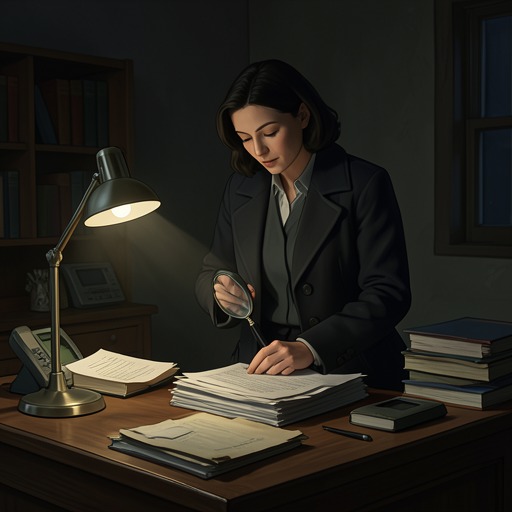
When he comes to Maya’s house, the narration gives him a deliberately vivid physical introduction. He is short, hirsute, stocky, and broad, with arms that seem too short for his body. His face appears unshaven even after a shave; his bushy eyebrows and conspicuous hand hair complete the unflattering portrait. He enters with an attempt at swagger, looks around the house as police officers do, and remarks on the place. Maya responds with visible annoyance. The contrast between his self-conscious show of authority and her hostility makes their first face-to-face exchange immediately tense.
Questioning Maya and Following Evidence
Kierce’s questioning of Maya focuses on the gap between her account and what the investigation can verify. Maya says that Joe called her and suggested they meet in Central Park. Kierce checks his notes, turns pages, and tells her that Joe did not call. The contradiction is small in form but consequential in effect: before the investigation reaches its larger revelations, he has already shown that he is testing Maya’s story against recorded information rather than simply accepting it.
He also asks about the detail in Maya’s description of the attackers. She had identified the weapon carried by the man wearing red Cons as a Smith & Wesson 686, and the other attacker’s weapon as a Beretta M9. Kierce recognizes that this precision is impressive and asks whether it comes from her military training. Maya confirms that it does. His questions register both her unusual knowledge and the circumstances that explain it; her expertise helps the police act, while also drawing attention to the training behind it.
That practical value becomes clear when Kierce tells Maya that the police have picked up two suspects, then confirms that they found them through her description. His investigation therefore does not position her only as a witness under scrutiny. Information she supplied has helped produce a concrete police result, even as he continues to question her account and assess what she knows.
The Link Between Joe and Claire
A major turn in Kierce’s investigation comes from ballistic testing. The .38-caliber bullets recovered from Joe Burkett’s body are checked against other cases in the police database. Kierce’s nervous scratching as he explains the result accompanies the news that the bullets match an earlier murder. The first murder occurred four months before Joe’s death: the same gun killed both Joe and Claire Walker.
The disclosure changes the meaning of the two deaths. They are no longer separate losses connected only by Maya’s family; the shared weapon establishes a direct forensic link between them. Kierce delivers that finding to Maya, and the scene’s restrained exchange makes the evidence itself the shock. Later, Shane Tessier tells Maya that Kierce had told him the same gun killed Joe and Claire, confirming that the investigative finding has circulated beyond their first conversation.
The Bribery Allegation and Its Reversal
Kierce becomes a suspected participant in the Burkett family’s affairs when Caroline tells Maya that she found several payments made to him among the family’s transactions. Caroline describes the transfers as just under ten thousand dollars each, three times. She presents them alongside a broader pattern of money moving through numbered accounts and offshore holdings, and identifies Kierce by name as a recipient. Maya takes the claim seriously enough to consider confronting Judith and Neil, though she recognizes that a direct accusation might give them time to hide or destroy evidence.
Maya later tells Shane about the alleged payments, and Shane reacts with disbelief. He says that he called Kierce that morning, apparently because Maya had made a serious accusation the night before. This episode shows how quickly suspicion changes the relationships around the investigation: information that Maya is trying to assess becomes an accusation that prompts Shane to approach the detective directly.
The payment claim also follows Kierce into a later investigation. At a scene where a possible wound to the throat is being examined, he asks about the cause of death. Maya identifies what she thinks is a slit throat, while the examiner describes an apparent knife wound and says the findings are not yet complete. Kierce then sits beside Maya and says that the investigation may have been proceeding on the wrong assumptions. Maya considers raising Caroline’s bribery allegation but judges that moment unwise. The claim remains unresolved between them in that exchange, not established as fact.
Its eventual status is made explicit when Maya confronts Judith. Maya explains that Caroline’s story about the payments to Kierce was one of several fabrications: the family fed her false information about both the money and the possibility that the Burkett brothers were alive. The false allegation was part of a larger effort to make Maya doubt her interpretation of events. Kierce’s name had been used to lend the deception investigative credibility, but the story does not establish that he took bribes.
Later Investigation and Narrative Role
In a later confrontation, Kierce tells Maya that investigators found blood in the trunk of her car. He specifies that it is AB-positive, the same blood type as Tom Douglass, and asks her to explain how it got there. The forensic detail turns the questioning toward Maya herself and places her under pressure to account for a physical trace. She remains still, then counters with Caroline’s allegation that he has taken money from the Burkett family. Kierce denies it. The exchange sets his evidentiary challenge against her attempt to undermine his authority, while the reader already has reason to treat the bribery claim cautiously.
Kierce’s importance lies partly in this repeated reversal of investigative roles. He questions Maya about inconsistencies, weapons, and blood evidence; she, in turn, questions whether his investigation is compromised. His presence gives those suspicions a face, but the later disclosure that Caroline’s accusation was fabricated prevents suspicion from serving as proof. Across the investigation, his verified contributions are concrete: he tests Maya’s account, relays the discovery that Joe and Claire were killed with the same gun, and confronts Maya with evidence connected to Tom Douglass. What others claim about him is less reliable. That contrast makes Kierce a point where the story’s central distinction—between evidence and a persuasive but false explanation—becomes visible.